


AI and the Climate Crisis Pose Existential Risks. The Law Offers a Way to Reduce Them | Robert Reich
The most basic function of government is to protect people from harm. Two growing phenomena – the climate crisis and AI – pose escalating risks of extraordinary harm.
The climate crisis is already causing floods, wildfires, drought and record heat. AI agents are already escaping super-secure environments to hack into systems they’re supposed to avoid.
Yet Donald Trump and his Republican enablers, backed by big money from big oil and big AI, refuse to do a thing about either risk. In many ways, they’re worsening both.
But there’s another way to reduce these risks: through liability law.
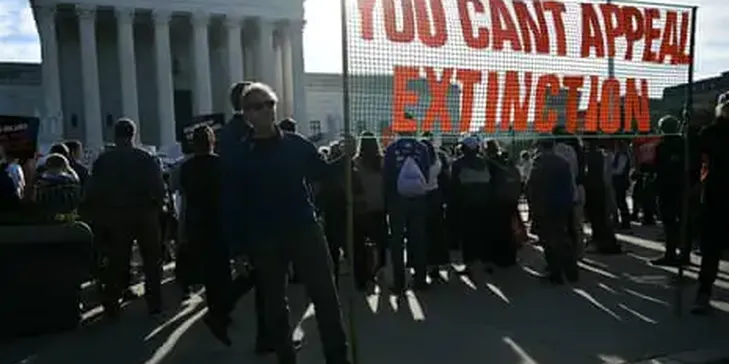
I have no more faith in the supreme court than you do, but I was struck by the responses of at least half the justices who will be considering an important case that opened the supreme court’s new term, Suncor v Boulder.
The case was brought by several Colorado localities against Suncor and ExxonMobil – one of about three dozen filed around the country in which cities and states are demanding that big oil reimburse them for the escalating costs of climate disasters brought on by the burning of fossil fuels.
On Monday, at least four justices (Samuel Alito has recused himself) expressed skepticism about big oil’s argument that the Clean Air Act explicitly prevents such lawsuits against polluters. “It’s like, wow, like, where is the text for that? Where’s the support for that? Where’s the precedent for that? Where’s the anything for that?” asked justice Elena Kagan.
Chief justice John Roberts drew parallels between Boulder’s claim and prior lawsuits against the tobacco and opioid industries in which states and localities won significant damages. “I’m not quite sure what makes this situation different from all those other ones where we’ve allowed them to proceed in state court,” said Roberts.
In 1998, the leading US tobacco companies agreed to pay $206bn to cover public health costs and smoking-related expenses. When translated into current dollars, this is more than $423bn.
And recall the $20bn paid by BP in 2010 to cover environmental and economic damage to the Gulf Coast after the Deepwater Horizon oil spill. Or the $7.4bn paid by the Sackler family and Purdue Pharma to resolve liability for the opioid crisis.
Such liability lawsuits – the last resort when the public is harmed by corporate malfeasance or nonfeasance – are also relevant to the risks posed by AI.
If AI agents escape super-secure environments to release dangerous toxins, or destroy critical water, electricity, transportation, or health infrastructure, AI companies and the tech giants behind them could be on the hook for tens if not hundreds of billions of dollars in payments to those who are harmed.
No way major investors in AI – or the insurance companies backstopping AI – are going to ignore this potential liability. The current dollar value of the tobacco settlement – as I said, $423bn – is comparable to what the tech giants spent on AI chips, servers, and datacenters last year.
This gigantic financial risk will weigh on the values of AI companies and the tech companies unless or until they become far more serious about protecting the public against such harms.
I expect political demands from the AI industry to limit such liability through federal laws that set caps on it and that establish industry-funded “trust funds” to pay for big liability judgments. A sane Congress (we may yet have one) wouldn’t agree without specific industry steps to dramatically increase safety.
In all likelihood, the AI industry will also seek government regulations it could use as partial defenses against such massive liability, just as pharmaceutical companies use certification by the Food and Drug Administration that their drugs are safe and effective to defend against lawsuits claiming their drugs cause harm.
The big AI investors and insurers will force this issue. More than 200 cases already in the courts involve cyber-liability and AI-related product liability. Follow the money. Insurers are already demanding more effective means of controlling AI risks, and big investors are demanding better means of limiting them.
Both the climate crisis and AI pose existential risks to human life on this planet. Liability law is hardly an easy or perfect fix, but it’s an important start.
The fact that liability for the climate crisis is already in the supreme court and that four justices seem sympathetic suggests how significant a role liability can play as an incentive for both fossil fuel and AI giants – and their insurers and major investors – to clean up their acts.
-
Robert Reich, a former US secretary of labor, is a professor of public policy emeritus at the University of California, Berkeley. He is a Guardian US columnist and his newsletter is at robertreich.substack.com. His new book, Coming Up Short: A Memoir of My America, is out now in the US and in the UK