


Revealed: The Methane Mega-Leaks from UN Climate Summit Host Turkey
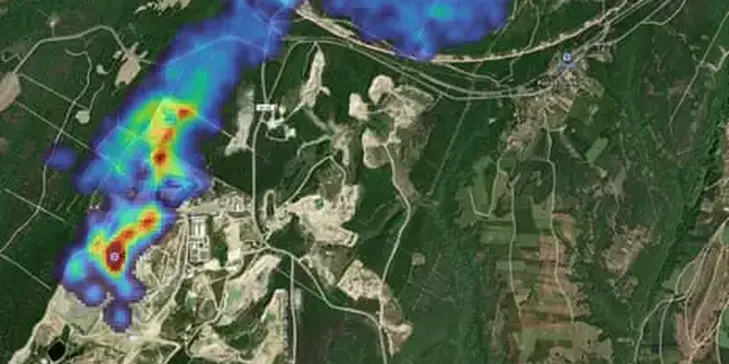
Two or three nights each week, the smell descends. Residents of villages on the rural outskirts of Istanbul don’t know what the smell is, but they have been plagued by it for years: a smell so bad they have to sleep with their windows closed even during hot summer nights. They know the source, too: the huge Silivri municipal waste dump a few miles away that is belching out stinking gases as food and other organic waste rots.
“The smell is not subtle. It suffocates you,” said Kemalettin Özenç, sitting outside a tea shop in the village of Yolçatı. “It’s worse when the air is still: sometimes families linger until midnight out here. Even when you go inside it’s inescapable.”
These gases are more than a local problem. They include methane, a potent climate-heating gas, pouring out of the site in such vast quantities that the plume is visible from space. Satellite surveillance shows that the Silivri landfill is Turkey’s worst super-emitting waste site.
In fact, its average emission rate of 7.4 tonnes an hour makes it one of the worst identified anywhere in the world by a team of expert researchers at the University of California (UCLA). The planet-warming impact of this single leak is equivalent to 1.5m gas-guzzling SUVs gunning their engines and there are more super-emitting dumps across Turkey. They stretch from İzmir in the west, to Ankara in the centre and Antalya in the south, many with “mind bogglingly large” leaks, the UCLA researchers said.
The revelation that Turkey has some of the world’s worst landfill methane leaks comes at an awkward time: in November, the country will host the next UN global climate summit, Cop31, and has put cutting methane emissions at the top of the action agenda it wants all nations to agree on. Turkey’s first lady, Emine Erdoğan, has been a prominent campaigner for zero waste and methane cuts on the global stage – despite the super-plumes now revealed at home – and the president, Recep Tayyip Erdoğan, said waste management was a priority in a speech he made in June.
‘They Have The Power’
On the ground, the problem has festered for some time. Özenç and a growing crowd of disgruntled people in his town and others around the Silivri landfill have spent years looking for someone to intervene, but the notion of contacting the Istanbul municipality who operate the facility did not cross their minds. Some took to the internet to leave outraged messages about the smell underneath the dump’s listing on Google maps, while Özenç tried to rally people to sign a petition intended for the forestries ministry which oversees several nearby mines.
But in the end, too many were afraid to sign. “They have the power and can say whatever they want,” he said, in a sweeping reference to the authorities. Turkey’s most notorious maximum security prison looms 30 minutes from Yolçatı: the mayor of Istanbul, Ekrem İmamoğlu, was accused of corruption and detained there in 2025. Özenç and others in the community feared what might happen to them if they were seen to complain too publicly.
Staff from the Istanbul metropolitan municipality’s waste management division, İstaç, at the site in Silivri appeared surprised when shown satellite images of the massive gas leak emanating from a spot visible from their office windows. Methane, also known as natural or fossil gas, is transparent, and so the plume coming from the site is invisible to the naked eye.
Fatih Arslan of İstaç cleared his throat while staring intently at the satellite images presented to him by the Guardian. “Well there’s not much to say,” he said, initially blaming the emissions on areas of the waste site not yet covered with clay after the dumping process. “It’s inevitable that this is happening … of course we have to make improvements,” he ventured.
Their priority, he explained, was to cover exposed areas of the dump as quickly as possible and trap the methane produced by the rubbish for use as fuel. An on-site facility extracts 6,000 cubic metres of methane an hour from the landfill to burn for energy: letting methane leak into the atmosphere, he said, is therefore a waste.
For the head of the facility, Ebu Bekir Ikinci, the current situation is actually a vast improvement on the past. He showed newspaper headlines from Istanbul in the 1990s, when the streets were piled high with rubbish and, in 1993, methane trapped at a dump exploded, killing 39 people. A year later, Erdoğan became the mayor of the city with a promise to bring in better waste management.
“The baseline scenario we use for emissions from waste is what would happen if the waste was not stored at all,” said Arslan, pointing to the deadly scenario from the 1990s. “Compared to that, the emissions now are way better. This is actually very good.”
‘Mind-Bogglingly Large’ Rates
Silivri is the largest landfill in Turkey, processing 10,000 tonnes of waste every day. Another waste dump in outer Istanbul, on the other side of the capital in Şile, is also a source of huge methane leaks, pouring 4 tonnes of methane into the atmosphere every hour, the global heating equivalent of about 800,000 SUVs. The UCLA team used satellite data from the Carbon Mapper portal to identify the 10 highest-emitting landfill sites across Turkey.
“Many of these sites have mind-bogglingly large methane emission rates, even in a global context,” said Cara Horowitz, who leads the UCLA Stop Methane project, which carried out the analysis, and is executive director at the Emmett Institute on Climate Change and the Environment. “These are huge leaks, some of the largest single manmade sources of methane emissions in the world,” she added.
Methane emissions cause a quarter of all global heating and there has been a “scary” surge since 2007 that risks triggering catastrophic climate tipping points, scientists have said. However, cutting methane emissions is often relatively easy to do and has a rapid impact because the gas is naturally removed from the atmosphere far faster than carbon dioxide. Some experts call cutting methane the climate “emergency brake”.
Turkey says that as the Cop31 host, zero waste and methane reduction are the highest priority on its action agenda. Murat Kurum, Turkey’s environment minister and the Cop31 president-designate, wrote to the 196 nations due to attend the summit in Antalya, saying: “Reducing methane emissions is among the fastest and most effective strategies for slowing near-term temperature rise. The waste sector therefore represents a critical opportunity for delivering immediate climate benefits.”
However, Turkey’s environment ministry declined to comment when contacted by the Guardian about the nation’s methane super-emitters. The Istanbul municipality also declined to answer questions about the methane emissions at Silivri and refused permission to photograph the site.
Reducing emissions from waste disposal has also been described as the “personal project” of Emine Erdoğan, who is the honorary president of Turkey’s Zero Waste Foundation and chair of the UN Advisory Board on Zero Waste. While opening a “zero waste forum” in June, she noted that some landfills in the world were filled with discarded food while people went hungry, and that food waste causes enormous methane emissions. However, Turkey is not among the 159 countries to have signed the Global Methane Pledge to achieve a 30% reduction in these emissions by 2030.
Waste Opportunity
Turkey could become a global leader in cutting methane emissions, Horowitz said, if it managed to clean up its many polluting landfill sites. A suite of tried-and-tested solutions exists across the world, ready for adoption, which start with being aware of the leaks. “Landfills are a significant proportion of the top global methane super-emitters, so just making sure we’re accurately understanding the scale of these emissions is an important first step,” she said.
The official record of greenhouse gas emissions submitted to the UN by Turkey acknowledges that a major contributor to its emissions from the waste sector “is the uncontrolled release of methane gas from landfills into the atmosphere”, and that such gases are meant to be monitored by the environment ministry. However, legislation enacted last August – intended to launch a monitoring mechanism for emissions from select Turkish private interests – only monitors carbon dioxide emissions, and excludes any facilities “using biomass” like landfill.
Methane gas coming off landfills can be captured and used as fuel, as at Silivri. However, Dr Tia Scarpelli, waste sector lead at Carbon Mapper, said: “Not all sites that have gas collection are created equal. It does come down to the design and efficiency of the system and day-to day management practices.” Causes of major leaks can include poor maintenance, failure to keep flares alight when burning off excess methane, or collecting only good quality gas and venting the rest.
A more foolproof way of halting methane leaks is to stop organic waste going into the landfill and rotting in the first place. In South Korea, close to 100% of the country’s food waste is now recycled. “Getting at the real source of the problem is an even better opportunity to reduce methane leaks,” Horowitz said.
Stopping the massive methane leaks in Turkey is a climate imperative, but may yet fall victim to politics: Istanbul, Ankara, İzmir and several other big cities remain under municipal opposition control, despite a prolonged crackdown on Turkey’s largest opposition party. Imamoğlu and hundreds of other former employees from the Istanbul municipality are on trial on corruption charges, and the government in Ankara is eager to claim the opposition are incapable of running Turkey’s largest city, including its waste management.
After his petition went nowhere, Özenç said he and other communities in Silivri living with the unbearable smell feared another instance of what he saw as a “cover up”.
“It’s not like we have a say anyway,” he added. “What can you do? The moment you talk about this, there is silence.”