


The American Dream Remains Elusive in the Valley that Inspired East of Eden
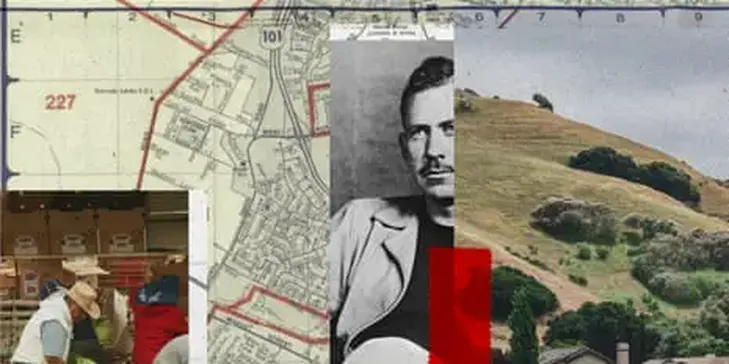
Nestled between two mountain ranges at the crook of central California’s coastline sits a valley known as the “salad bowl of the world”.
Farm workers stoop over neatly lined rows of crops off Highway 101 to harvest more than half of the nation’s supply of lettuce and nearly a third of its strawberries. The soil here is so rich that author John Steinbeck made the Salinas valley the promised land in his literary depictions of people chasing the American dream: immigrants, farm workers, westward-moving hopefuls, hungering for a better life.
It’s a story that continues to capture the American imagination: Netflix has adapted Steinbeck’s 1952 blockbuster novel, East of Eden, into a limited series starring Florence Pugh, released 1 October.
“This will be a valley of great richness one day,” Steinbeck wrote of the farmland in East of Eden. “And happy people will live here, thousands and thousands.”
But Steinbeck also understood just how difficult it can be to achieve that elusive American dream. Even after some his characters found their way to Salinas and other parts of California’s agricultural valley, many remained stuck in low-paying jobs, making barely enough to scrape by, let alone own their own land.
That reality persists in the Salinas of today – an area at the sharp edge of a national affordability crisis that is reshaping politics across the US, and much of the rest of the world.
A recent Brookings Institution analysis found that Salinas is the least affordable city in the US for the middle class, defined as the middle 60% of income earners. Nearly 60% of the middle class in the Salinas area – which spans households making $38,000 to $193,000 – can’t afford basic necessities, double the national average, according to the analysis. And for Salinas’s Latino middle class, which make up 40% of all middle-class households, three-quarters struggle to afford everyday life.
Residents specifically say that homeownership, the modern symbol of the American dream, is out of reach. It’s an issue that is playing out across the country: half of all renter households and about a quarter of homeowner households spend more than 30% of their income on housing, according to the latest data from the US census.
“It really calls in question: what is the middle class?” said Andre Perry, a senior fellow at Brookings who oversaw the study. Many towns like Salinas that served as havens for the middle class are now out of reach. “People go to Salinas as a reprieve from San Francisco and some of these high-priced cities, but in actuality, they’re finding it more difficult to live,” he said.
Solutions are not easy to come by. The rising cost of living has torn Salinas apart. New housing has grown at a snail’s pace, and a rent-stabilization policy has bitterly divided residents.
If life in places like Salinas becomes too expensive for American families, where do they go next?
‘Everything’s Changed’
Steinbeck had a conflicted relationship with his home town, said Gavin Jones, chair of the English department at Stanford University and a Steinbeck scholar, one that he often reflected in his writing. For many of Steinbeck’s characters, California and its farmland ultimately prove to be gutting disappointments after everything they sacrificed to get there.
“It’s kind of the promised land. It’s this realm of richness,” said Jones of the role Salinas played in Steinbeck’s magnum opus. “But then of course, it’s also a fallen paradise … it’s not quite Eden, it’s east of Eden.”
Steinbeck was born to a solidly middle-class family and was raised in a turreted, Victorian-style house that still stands just a few blocks away from Salinas’s downtown. He was long critical of the hypocrisy and “underbelly” he saw in his social demographic, Jones said, and worked alongside immigrant workers on nearby farms while dropping in and out of Stanford University.
Steinbeck was also “very American” in his idealized vision of social mobility, ascendancy and agency, Jones added, and would have likely been outraged at the affordability struggles many still face in the US, accentuated by the increasingly “K-shaped economy” with the rich getting richer as the poor slide down the other side.
“One wonders if the conditions are that much different today in the central valley, especially for agricultural workers … from the conditions that Steinbeck represented in the 1930s,” Jones said.
Gaye Freedman, 75, and her husband had been searching for somewhere affordable to live for years before they moved to Salinas in 2017, where their son was raising a baby as a single dad. Though they passed up more affordable cities in northern California, the beautiful, year-round weather – cool, foggy mornings that give way to balmy afternoons – as well as proximate medical care for older adults made their decision easier.
But Freedman, who earned a doctorate degree in educational psychology from the University of Southern California, was unable to find much work in Salinas that paid much beyond minimum wage. She currently works part-time at a school.
Between part-time jobs and social security, Freedman and her husband make about $75,000 total and pay $1,850 for their one-bedroom apartment, which became a rent-stabilized unit in 2024. After rent and Medicare payments, they don’t have much left to spare on groceries, gas and unexpected maintenance on their 14-year-old car. The balance on their credit card, she said, keeps climbing.
“This is the first time in my life I’ve actually had to think about what I’m cooking, because I can’t afford to cook what I usually would,” she said. “We’re eating a lot more stews and spaghetti and chicken. I’m definitely thinking of what lasts more than one day.”
Freedman and her husband have considered moving, but many of the affordable cities nearby lack medical care facilities or infrastructure that will be crucial for the couple as they get older.
Other residents cited similar concerns of getting pushed out by the cost of living. Salvador Herrera, 52, a former construction worker who grew up in Salinas, said gone are the days of his childhood where a family could raise their children in their own apartment unit or home. In Salinas, it is now common for multiple families to live together: garages are partitioned with curtains; single bedrooms are crammed with young children and parents; and bathrooms are shared among dozens.
Herrera supports his family using disability payments after an injury on the job left him unable to work. Rising rent has sometimes meant weeks where he has just $50 to spend on groceries for himself and his two children.
“Everything’s changed. Especially the housing, it’s way too expensive. And the pay is cheap nowadays,” he said.
Salinas’s close proximity to Silicon valley leaves it vulnerable to the same housing woes faced by the rest of the Bay Area, housing experts say.
Its surrounding farmland also makes it difficult to expand and build there, all of which has led to a persistent lack of housing supply that has pushed up prices for years. Meanwhile, the median household income in Salinas is just shy of $90,000, compared with a median of roughly $150,000 in San Jose or San Francisco.
“We got caught up early on Bay Area economics,” Salinas mayor Dennis Donohue said at a Starbucks across from the Salinas Sports Complex, where he was attending an agricultural biotechnology conference. “You have all the economic challenges of the Bay Area impacting Salinas and this area without corresponding economic opportunities.”
All of this pressure comes even as California is home to some of the most progressive housing policies in the US, with rent caps on most households statewide and further protections at the local level. Still, residents face the highest median monthly housing costs in the country, according to the latest census data.
Critics on both sides of the political aisle have in part criticized the state’s governor, Gavin Newsom, for the state’s cost-of-living crisis, including sky-high housing costs. Newsom, who is considering a presidential run, has blamed Trump but may well find voters – and his opponents – put the blame closer to home.
Meanwhile, housing is one of the most potent issues at the voting polls: a recent survey from CNBC found that the high cost of housing was the most pressing concern for voters aged 18 to 34 years old.
Trouble In Paradise
The Salinas city council sent Freedman and many more struggling households a lifeline in 2024, when it passed a rent-stabilization ordinance that capped annual rent increases on certain multifamily rental properties to either 2.75% or three-quarters of the annual inflation rate, whichever is less. Freedman says she’s saved thousands of dollars already because of the caps her landlord now places on her rent increases each year.
But the town has been heavily divided on the policy. When a new city council board took over the next year, it repealed the policy, arguing the ordinance unfairly penalized apartment property owners and would discourage much-needed housing construction.
A referendum vote was announced for this November after advocacy groups gathered enough signatures. Rent stabilization will remain until then, but it’s unclear where voters will land.
It’s a deeply emotional issue for Salinas, said Tony Barrera, a longtime resident and a city council representative who was among the minority who voted to keep rent stabilization in 2025. His district is overwhelmingly supportive of keeping the measures in place: 70% are renters and 80% are field workers, he said. About a third are undocumented, which means they won’t be able to vote in the fall.
But he also raised concerns that landlords in his district would not be able to afford their mortgage or property maintenance with the ordinance. If they sell their homes, he added, that could end up driving rents up further for his constituents.
“I’m caught in the middle,” he said.
Matt Huerta, an affordable housing expert based in Salinas and an advocate for rent stabilization, said that landlords can apply for exemptions if they need to raise rents higher than the ordinance allows.
“We recognize that sometimes costs are higher than inflation. Sometimes tariffs come in, and all of a sudden you can’t get that refrigerator or water heater,” he said. “There’s an application process for that.”
Amy Salmina, a property manager in Salinas, said many of the middle-class homeowners she works with have been selling their properties due to rising costs. Most are in their 60s and bought rental properties as investments, but rising property taxes and insurance have ultimately handed them greater losses.
Housing specifically for the middle class is severely lacking in Salinas, she added, and economic opportunities aren’t keeping up with growth.
“We have so much help [for] the low-income, which is great,” she said. “But we’re forgetting about the middle class,” she added, referring to families who make “too much money to get any assistance or to get lower-income housing”.
Salmina’s family has lived in Salinas for four generations, but she is doubtful that her children will be able to afford to stay.
“My son’s a firefighter. I don’t even know how they’re going to be able to buy a house,” she said. “I told all my kids: ‘Look, unless you have two incomes, you guys won’t be able to stay here.’”
Those fighting against rent stabilization say that the law would exacerbate the town’s housing crisis, because it could disincentivize investors or developers looking to build in the area. But advocates argue that the city’s rent-stabilization ordinance only applies to buildings built before 1995, so newly built units can still be listed at market price.
For years, the city has struggled with a housing supply that hasn’t kept pace with its population. Even though the Salinas city council approved a plan in 2008 to build 11,500 new residential units, the Great Recession made it nearly impossible to finance any new construction, said Donohue, who had been in the middle of his first mayoral term at the time.
New construction was also stopped by Covid and has been slow to pick up even six years later. Now, with mortgage rates surpassing 7%, a 20-month high, and the US Federal Reserve poised to raise interest rates further, borrowing costs are exacerbating the crisis.
But Donohue has optimism for the future of the town, which he says exports “vegetables and too many of our kids”. He and other local officials are trying to bring more job opportunities to the area, while the city council recently approved a down payment assistance plan for first-time homebuyers.
“I’m the mayor of the hometown of John Steinbeck,” Donohue said. “If any city should know how to tell a story, it should be this one. I’m confident the city, the book, will have a happy ending.”
He just can’t tell you how long it will take.