


Arsène Wenger and Arsenal: 30 Years on from Appointment that Changed English Football
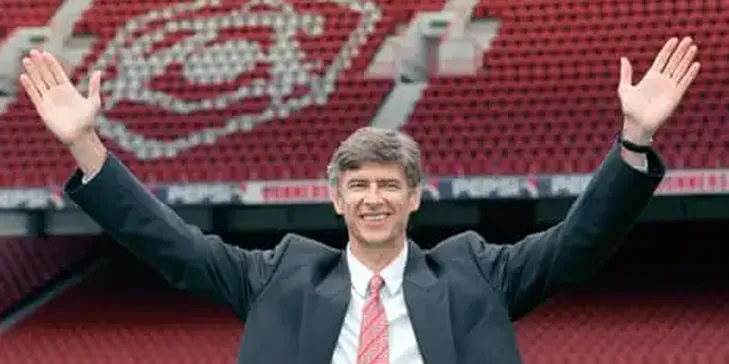
As feedback goes, even a character as relentlessly optimistic as David Dein might have considered the reaction to his bold managerial appointment suboptimal. Thirty years ago, Arsenal were in a state of chaotic flux, having sacked Bruce Rioch, with the interims Stewart Houston and Pat Rice in charge. There had been talk of Johan Cruyff arriving and Dein wanted to fill the information vacuum. Summoning the team, he reassured them a new manager would soon be appointed and that he was a world-class addition.
“His name is Arsène Wenger,” Dein, the club’s vice-chair, beamed. A brief pause ensued before a player’s voice called out: “Who the fuck is he?” His exclamation echoed conventional wisdom. “Arsene Who?” famously read The London Evening Standard’sbillboards prior to Wenger being confirmed as manager on 30 September 1996.
Ultimately Dein’s decision was arguably the most seismic managerial appointment in modern English football history, not only providing proof that a foreign manager could succeed in this country but also ushering in an irreversible era of multiculturalism, giving birth to the globalised Premier League we know today. Wenger described the Arsenal dressing room he inherited as “culturally English” and set about making his first signings, the characteristically unknown Frenchmen in Patrick Vieira and Rémi Garde; when he departed the job in 2018, every Premier League dressing room was a veritable United Nations.
He was the trailblazer, preceding Gérard Houllier and Rafael Benítez at Liverpool and, ironically given their mutual animosity, José Mourinho at Chelsea, all beneficiaries of his success. On the flip side, there would never have been Tottenham’s ill-advised experiments with Christian Gross and Jacques Santini were it not for Wenger.
Undoubtedly he was the right man at the right time: Chelsea were already embracing the continental drift, having appointed Ruud Gullit, and Wenger’s arrival chimed with contemporary geopolitics. Tony Blair was about to become prime minister and a wave of European Union migration was coming; Polish plumbers and French footballers alike. Equally, Sky TV’s money was making England the best-paid country for footballers.
The first non-British or non-Irish manager in the top flight had been Dr Jozef Venglos, appointed by Aston Villa in 1990, ticking all the boxes of English football’s old prejudices: foreign, academic, whimsical, tactical. Gratifyingly for sceptics, he was an utter failure. Wenger seemed to fit the Venglos mould. Nicknamed Le Professeur (because he wore glasses and spoke five languages), his captain, Tony Adams, thought him a “geography teacher”, while Ian Wright noted his clumsiness and dubbed him Clouseau, taking delight in pranking him about a bomb scare. “There is bum?” replied a bemused Wenger, oblivious to the hilarity among Wright’s teammates.
“Arsène Wenger’s been in Japan, he doesn’t know anything about the English game,” said Sir Alex Ferguson, laying the foundations for a decade-long feud that would become, in Ferguson’s words, “toxic”. Yet even the bastions of the English game acknowledge the magnitude of Wenger’s contribution. “Wenger changed the whole course of [English] football,” says Neil Warnock, not a natural soulmate. “He made people who’d been in the game a long time [realise] that you had to change with the times because of all the nutrition coming, the fitness guys who were coming, and that if you didn’t move with the times, you got trodden on.”
Wenger’s aesthetic playing style was encapsulated upon securing his first Premier League title in 1998, with a pastiche of Total Football that culminated in Steve Bould drifting out of the back four to chip a pass on to the advancing Tony Adams, who finished perfectly in a 4-0 win over Everton. “Would you believe it?!” said a stunned Martin Tyler in commentary, reflecting the views of the nation. “That sums it all up.” Derided as a donkey, Adams had become a thoroughbred.
Wenger’s genius was in maintaining an English core to his early side, grafting on Vieira, Emmanuel Petit, Marc Overmars and allowing Dennis Bergkamp to flourish. “There were rumours that he was advised to get rid of the back four,” said Nigel Winterburn, part of that legendary quartet. “But I think he made his own decisions when he saw the players playing and training, and saw the desire they had.” Later Thierry Henry, Robert Pires and Freddie Ljungberg would arrive to reach the even greater heights of the Invincibles.
Dr Yann Rougier joined as a sports scientist and Ferguson, in charge of a dominant Manchester United team, was instinctively suspicious of the new methods challenging his success. When the England manager Glenn Hoddle, a Wenger protege at Monaco, used Rougier at the 1998 World Cup and United players came back singing the praises of his nutritional approach, Ferguson was infuriated, demanding FA investigations. Yet most of the interventions nowadays would be regarded as standard, such as using creatine to supplement diets.
Chocolate was famously banned at Arsenal but Winterburn revealed the manager’s strictures were not always adhered to. “We’d wait for Arsène to walk [away], then most of the players would pile into the little kiosk and buy chocolate and eat Mars bars under the table.” What became known as the “Evian broccoli” diet was introduced just as Adams had announced himself an alcoholic, lager being the habitual post-match refreshment of British football. Adams attributed his late-career transformation to Wenger’s nutrition and his teetotalism. Eschewing alcohol is unremarkable among elite England players now.
Hoddle had also been transformed by Wenger’s holistic approach to exercise. “We were in the dark ages [in England] by comparison,” he said. “I had never had a massage or done a warm-down at Tottenham. I became more supple and I was soon fitter than ever.” Wenger employed a French osteopath, Philippe Boixel, and used the English psychologist David Elliott. Arsenal were the first club to sign up with ProZone, using stats to analyse performance. There aren’t many innovations in modern English football not pioneered by him and, in that respect, his influence is greater than even Ferguson’s, even if his success never measured up to the Scot’s achievements. By the end, Wenger’s French revolution had become common practice; he was a victim of his own success, his competitive edge dulled.
Only when the prizefighters had laid down their gloves was Ferguson able to articulate his appreciation. “Arsène is, without doubt, one of the greatest Premier League managers and I am proud to have been a rival, a colleague and a friend to such a great man,” he said when Wenger left Arsenal. Wenger might raise a quizzical Gallic eyebrow at the “friend” description. But 30 years on, few dispute the scale of Wenger’s transformation of the English game.