


‘It Keeps Growing’: The Tent Camp that Stands Against Spain’s Housing Crisis
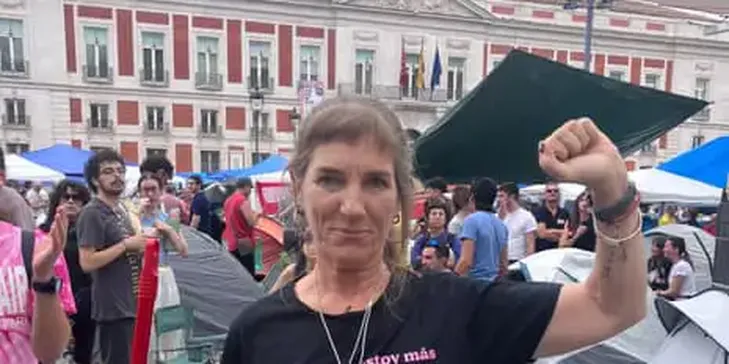
Wielding a broom and dustpan, Marta García, 60, darted past the edges of tents, sweeping up bits of litter as she passed a poster that read: “What kind of times are these, when we need to defend the obvious?”
On Saturday, as tens of thousands of people took to the streets of Madrid to protest against the country’s deepening housing crisis, the retired schoolteacher was among a small group who had sought to take the protest one step further.
“At first we were 10 tents,” she said, gesturing to the sprawling encampment set up in the central Puerta del Sol plaza behind her. “Now, we’re more than 300 tents, and it keeps growing.”
Days earlier, many across Spain had watched in shock as news channels showed Maricarmen Abascal, an 87-year-old woman with a disability, being evicted from the home where she had lived for seven decades. The shock soon gave way to anger as the octogenarian was shown being brought out of her home on a stretcher, flanked by protesters on one side and police officers on the other.
Housing campaigners seized on the moment. “The whole country has seen that housing speculation has no mercy on anyone,” said Alicia del Río of the Madrid Tenants’ Union. “We’re not sad, we’re angry. And we’re not going to stop until we change things.”
Abascal’s lawyers reportedly reached a deal for her to return home on Monday evening. “If this agreement we have reached is signed, it will obviously be a better and happier outcome for everyone,” her lawyer, Beatriz Duro, told reporters, saying it could “help to change the paradigm when it comes to housing in general”.
At the encampment earlier on Monday, many described the days of nationwide protests and the encampment as a turning point in a movement that had long simmered as rents rose by 80% within a decade, while the cost of homes climbed by 63%.
“We need stability,” said David Iglesias, 25, as he described how the ever-soaring prices had forced people to put their lives on hold to try to keep a roof over their heads.
“People who want to have children should be able to do so, even if they are renting. People who dream of becoming musicians or barbers should have the chance to do so and not have to worry that they need to work, work, work to pay for housing,” he said. “It’s an endless loop that is undermining the mental health of young people.”
As he spoke, a large banner flapped nearby, reading: “You can speculate on watches, jewels, cryptobros and Ferraris. But not on our fucking homes.”
The swelling encampment had prompted a raft of comparisons to 2011, when the Indignados, or 15M movement, began with a month-long occupation of the same Madrid plaza before snowballing into a force that had reshaped Spanish politics. Iglesias, however, brushed off the similarity. “That was about a general demand for change,” he said. “But we have a goal, and if this goal isn’t met by Tuesday, we’ll have to take action somehow.”
It was a nod to the informal camp slogan, launched by housing campaigners and oft-repeated by protesters in recent days: “Either the rentier economy falls, or the government does.”
As Spain’s government gears up for its weekly Tuesday meeting, campaigners have put forward a list of demands, from measures to halt evictions to the regulation of short-term and room rentals, making it clear that this is being seen as a make-or-break moment.
On Sunday, Spain’s prime minister, Pedro Sánchez, said his government was “working around the clock to introduce a royal decree on housing on Tuesday”.
The protests have put the Socialist leader in a complicated spot; while his coalition government includes leftwing forces who have long pushed for change, Spain’s fractured parliament means his chances are slim of attracting support for measures that could bring about real change.
Still, the momentum has continued to grow across the country, fuelled by the campaigners who occupied the offices of Madrid’s social housing agency on Monday to those in Barcelona who began the day by blocking off major thoroughfares.
“Today cannot be a day like all others,” said Enric Aragonès of the Barcelona Tenants’ union, ahead of a protest planned for Tuesday evening in the city. “There are only 24 hours left until we find out whether the government will approve a decree that is a sham or genuine.”
In Madrid, the calls for change had attracted a diverse group, including Oscar-winning film director Pedro Almodóvar, who visited on Sunday to voice his support for the protesters. “The housing problem is paralysing Spanish life,” he told broadcaster RTVE.
Sitting cross-legged in a tent and knitting to pass the time, Guillermo Esteve said he was part of a group of vegans who had decided to show their support by joining the encampment. “We’re a group of people who believe we can do things better,” he said, describing his hope that this would be part of a sweeping change that would start with the real estate sector, then address the precarity of the labour market and eventually tackle production systems. “We want laws that give us hope, not what we have now.”
The sentiment was echoed by García, the retired schoolteacher. “This camp is an example of how people still believe that things can change,” she said. “I have my life sorted out; I have a house. But I have two daughters who are sharing bedrooms because they have no other choice. So I can’t just sit around doing nothing.”
This was how she had ended up in the heart of Madrid on a Monday afternoon, sweeping the city’s central plaza, she added with a laugh. “Look, if I didn’t think this was going to amount to anything, I would just stay home and cry,” she said. “But I have to stay helpful.”
With contribution from Stephen Burgen in Barcelona