


‘I Never Choose the Cautious Option’: Royal Opera’s Jakub Hrůša on Collaboration, Control and Conducting Wagner
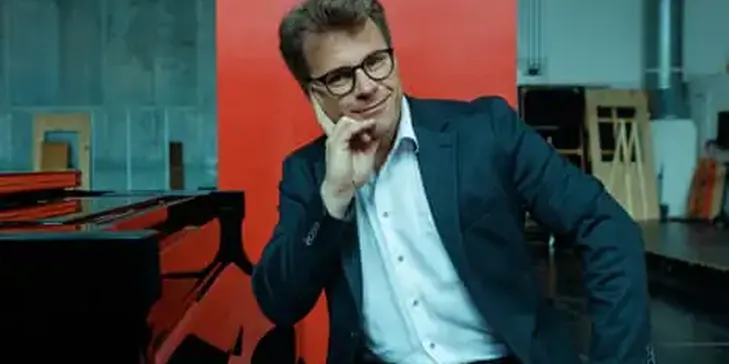
‘You can choose the cautious option – or you can take the full risk and just go and conduct. Maybe I would like the cautious option, but I never choose it.” Jakub Hrůša learned to trust his instincts at the Royal Opera House back in 2022 when he conducted his first ever Wagner opera – Lohengrin – there, describing the experience as “one of the absolute highlights of my life”. Now he’s a year into his role as the house’s music director and about to conduct his first Parsifal, staged by Evgeny Titov. And next season there’ll be yet more Wagner firsts when he conducts complete cycles of the Ring as staged by Barrie Kosky. For most conductors, this would be a gradual process, adding the four Ring operas to their repertoire one by one, but not for Hrůša: he’ll be conducting his first Das Rheingold, Die Walküre, Siegfried and Götterdämmerung all in the space of a week.
“Is it too bold? I find it wonderful!” he says. “I could have chosen to do it in my own way, in 10 years’ time, somewhere else – but I’m here, I’m the music director, the Ring should be done and wants to be done in its entirety, and I am courageous.”
double quotation markThere’s so much a conductor can influence in a show: the energy, momentum, atmosphere, detail, security, freedom...
Hrůša conducted Kosky’s staging of Carmen here in 2018, and they worked together at the 2024 Salzburg festival on Katya Kabanova by Janáček – another son of Brno, Hrůša’s home town. Each of Kosky’s Ring’s three instalments so far has been led by Antonio Pappano, with the fourth, Götterdämmerung, scheduled for January, also with Pappano. His 22-year tenure as music director was the longest and most stable in the Royal Opera House’s history, so those are big shoes to fill, both in the Ring and in the role more generally.
“I think when someone leads an opera house successfully for such a long time, it has two effects,” Hrůša says. “There’s this positive habit, an expectation of quality. But the longer the tenure has gone on in this way, the more necessary it is to consider the change positively. So there’s no contradiction between gratitude and love for Tony [Pappano] and eagerness to have a change. The only thing I’ve heard in the house, before I started and after, is: ‘We want you to do it in your own way.’”
We’re talking at the Royal Opera House after Hrůša has spent the afternoon rehearsing Parsifal. The story mingles Arthurian legend with ideas from Christianity and, less explicitly, Buddhism; Titov’s production, described as dystopian and advertised with the line “What if the light is a lie?”, promises to be uncompromising and potentially iconoclastic. For all his experience of conducting norm-challenging productions – think of Kosky’s deconstruction of Carmen or Katie Mitchell’s feminist Makropulos Case here last season – Hrůša doesn’t give the impression of being one who seeks controversy. “But I think that’s what theatre should do: if something is really shocking or provoking or uncomfortable, it should be a method to get us to something which we wouldn’t see otherwise – a way to get to the core of an important question about our lives.”
double quotation markPeople think that the mark of a good conductor is that everyone does what you want. I disagree.
As for doing things Hrůša’s own way – so far, he says, any changes he has made have been subtle ones. He speaks with genuine enthusiasm about the “totally accessible, really open-arms” spirit he found at the house regarding new audiences, and proudly gives figures to back this up, including the fact that nearly half of tickets sold by the Royal Ballet and Opera last season went to newcomers. “And I would like anyone who has any doubts about opera as an art form to experience the atmosphere at our schools matinees.”
Nor will existing audiences find big changes in repertoire. The post of music director comes with the expectation that he will conduct three or four productions a year – last season it was Puccini, Janáček and Britten; this season Wagner, Janáček and Verdi. As he is a Czech conductor, it’s not surprising that Hrůša has an affiliation with Janáček: “He is a romantic soul speaking through modern musical language and modern topics, and I always say with astonishment that he was born before Mahler, Strauss, Puccini, Debussy!” Going forward, he says, there will not necessarily be more Czech repertoire at the house, but it might appear “with more regularity”.
Janáček might have seemed a more obvious choice than Britten’s Peter Grimes, which Hrůša conducted with enormous impact earlier this year, but he credits Glyndebourne productions of The Turn of the Screw and A Midsummer Night’s Dream for building his confidence with the British composer. He feels his role to be collaborative rather than dictatorial. “So many people think that conducting is about imprinting your vision from A to Z to the people you work with – that the mark of a good conductor is that everyone does what you want. I disagree. I think already the collaboration with the stage director needs to create space for another point of view, and I always try to turn it into enrichment of my own vision rather than fighting. Especially with singers of the calibre of Allan Clayton and Bryn Terfel” – his Grimes and Balstrode in Deborah Warner’s production of Peter Grimes – “I’m so eager to learn from their experience and to let their wisdom influence what I do.”
He’s keen to continue to re-establish the tradition of the orchestra and chorus giving concerts in the house – last September he unearthed Dvořák’s oratorio The Spectre’s Bride – and says he feels especially drawn to taking care of the orchestra, “cultivating it, not just the quality but stylistically as well”. This isn’t surprising either given that most of his positions so far – with the exception of three years spent as music director of Glyndebourne on Tour, starting in 2010 – have been with symphony orchestras. Hrůša has been chief conductor of the Bamberg Symphony for the past decade, ensuring that this punch-above-its-weight ensemble based in a small town in Bavaria has continued to be one of the leading orchestras in Germany.
It was to the UK, however, that he moved with his family, in 2018, soon after he had made his Covent Garden debut with that Kosky Carmen. They now divide their time between London, where his two children go to school, and Prague, with the occasional skiing trip when they get the chance (“that’s our passion, the whole family”). In two seasons’ time Hrůša will be cementing that London-Prague axis professionally when he takes on the top orchestral job in his home country: chief conductor of the Czech Philharmonic.
His predecessor-but-one in that role was Jiří Bělohlávek, and he’s proud to be following in his late teacher’s footsteps. “I started studying with him when I was 18 and then the relationship turned into a real friendship. We developed a habit of correspondence and also regular meetings. He always wanted to know what was up, and I would bring a recording or stories, and he did the same. He wanted me to be observing and giving him feedback. It’s so precious, because it’s quite hard to get honest feedback, especially if you are in a position of power. It’s another thing that needs to be cultivated.”
The proof of all of this careful cultivation comes in performance. “I think the core of what conductors do is non-verbal, and in a show there’s so much you can influence: the energy, momentum, atmosphere, detail, security, freedom – it’s an endless list. All that is totally in your hands, and you can destroy any of it by being insensitive.” A conductor’s most important job, he says, is to ensure that his performers are able to give of their best. “And if there’s the right mixture of safety and excitement, then the performer can give even better. That, I feel, is very much my mission. You don’t need to have a store of Parsifals behind you to try to provide this.”
Parsifal is at the Royal Opera House from 1-17 October. www.rbo.org.uk